help / about  | 
link here  |  tools  |  share:

fred1st
recent  |  interesting  |  random  |  favorites  |  contacts  |  sets  |  tags:
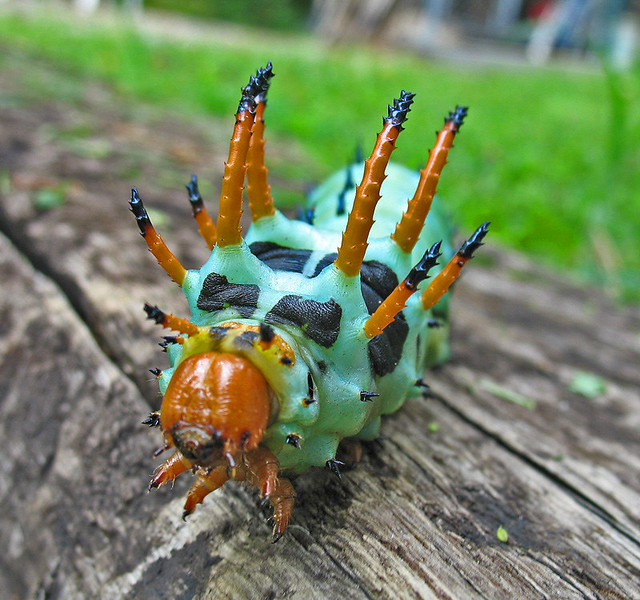
Hickory Horned Devil Hickory Horned Devil
Hickory Horned Devil

Yesterday, there was a knock on our door, and the visitor pictured here was paying a call. I am pleased to be the odd kind of fellow to whom neighbors bring caterpillars in plastic pails, although it seems to me that everyone along this country road should want a peek inside. This is the Hickory Horned Devil--a hideously beautiful creature that might just as well have come direct from the lot of a B-grade science fiction movie as from a modern-day forest floor. It is the unlikely preparatory stage required to build the elegant Regal Moth, a Beast and Beauty story if ever there was one. The Horned Devil is remarkable for size alone. It can be held in the hand of an adult only along the axis of the fingers, because otherwise, it's five-in-long, inch-thick body would drape over both sides of the open palm. It has the heft of a roll of quarters, gargantuan by land-invertebrate standards, and indeed, it is the largest caterpillar in North America by most reckonings. But will you reach into the bucket to lift such a thing up into the light of day? Make the creature the least bit agitated and it begins to thrash its front half back and forth and roll in alligator feeding-frenzy fashion in a most off-putting way, even if it is all just bluster: those spiny horns are harmless; there are no teeth in the terror for those who would merely hold and admire. However, to an actual predator hoping to make a meal of him, it's my guess that the Devil's thorny, bright orange warning spears are there for a reason--bad taste, bad smell or bad digestion probably lurk within, nature's fair warning to look but not touch if it's a meal you're after. I photographed this mammoth caterpillar and, perplexed, returned him to the bucket. That gaudy appearance, the horns in particular, had brought almost to mind some other thing, some larger context that I couldn't quite lift to the surface. Several hours later, it dawned on me that what I was reminded of by the Horned Devil's spiny, curved spikes was the feeding appendages Anomalocaris canadensis --the anomalous sea-dwelling creature of 550 million years ago whose parts each were at one time given the status of separate species. tinyurl.com/k23fj Science proceeded from error to error to put together the creature from its parts over more than a century; every explanation that came before was wrong, but was the best that could be done with what we had. We cobbled together the truth as the parts became known for what they are--or might be--until more light shines in the dark places of our ignorance. It's stretching the metaphor perhaps, but to my mind, the bizarre caterpillar I held in my hand today in some sense might be thought of as just such a fragment of knowledge. This creature is a partial truth, a single specimen of a single seldom-seen species that in the end, is integral to the astounding, ancient whole of nature's economy. We cannot even imagine. Every species is a small piece of an immense puzzle we poorly understand.

Taken on: September 2, 2006
↑ top